You’re halfway through cooking breakfast, and need to jump through the shower before work, but all of a sudden, everything goes quiet.
You just lost power and are now wondering just how long it’ll be out this time. A few hours? Long enough to start worrying about that full fridge or keeping your phone charged?
During California’s wildfire season, that scenario can become a real possibility when utilities call a Public Safety Power Shutoff (PSPS). These planned outages are used during periods of high wildfire risk to reduce the chance of electrical equipment starting a fire.
Having a backup power source can make the next outage a whole lot easier to deal with. The question is what kind makes sense for your home. Solar, battery storage, and generators each come with their own costs, capabilities, and trade-offs, so let’s look at how they actually stack up.
Why Wildfire Season Can Mean More Power Outages
A PSPS isn’t the same as the neighborhood losing power because a transformer blew.
California utilities can intentionally de-energize power lines when weather and fire conditions create a significant risk that electrical equipment could spark a wildfire. The California Public Utilities Commission (CPUC) considers these shutoffs a last-resort wildfire safety measure.
Utilities consider conditions such as strong winds, dry vegetation, low humidity, and field conditions when deciding whether lines need to be shut off. That means your power could go out before there’s a wildfire anywhere near your home.
Not every wildfire-season outage comes with a PSPS warning. In high-fire-risk areas, utilities might use sensitive protective settings that kick the power off when something contacts or threatens a power line. So, those outages can happen with little or no advance notice.
For you, either situation can mean waiting an uncertain amount of time for grid power to come back. When you’ve got backup power, you can count on that to pick up where the grid left off and keep certain things running.

Comparing Your Backup Power Options
Keeping your lights on and charging a phone or two takes a lot less power than keeping that plus your AC and fridge running during a power outage. That’s an important difference when you’re choosing backup power.
The devices and appliances you need to power will determine how large your system needs to be and, with batteries, how quickly you’ll burn through the energy you have stored. Solar, batteries, and generators handle those demands differently.
Solar Panels
If you already have rooftop solar, you might assume they’ll clock in and continue producing usable power when a PSPS shuts down the grid. But a standard grid-tied solar system usually won’t.
Solar inverters are designed to stop sending power onto utility lines during an outage. Otherwise, electricity generated on your roof could energize a line that utility crews expect to be dead while they’re working on it.
So, if you want your solar to provide backup power, you’ll need equipment that can isolate your home from the grid and supply electricity safely during an outage.
Pairing solar with a battery is a common setup. Your panels can keep producing electricity during daylight hours, sending some of it to your home and, when production exceeds what you’re using, recharging the battery for later.
Battery Storage
A home battery gives you a set amount of stored energy to work with when the grid shuts off. But the combination of devices you choose to run will determine how long that stored energy will last.
Limiting the power demands can help your electricity last longer. If you only provide power to the refrigerator, internet, lights, and a few outlets you can stretch that stored energy considerably longer than running central AC or other high-demand appliances.
Battery capacity is measured in kilowatt-hours (kWh), so comparing a battery’s usable capacity with the electrical loads you want to back up gives you a much better idea of potential runtime.
To put that into perspective, a typical household fridge uses 1.5 to 2 kWh per day. If you have a 13.5-kWh home battery (a common size) and the fridge were the only thing drawing power, that gives you a few days of stored energy to work with.
If you start adding lights, Wi-Fi, TVs, or AC to the mix, you’ll work through that battery much faster.
Batteries don’t burn fuel or produce exhaust, and properly configured systems can switch over to backup power automatically. Once the stored energy is depleted, though, you’ll need a way to recharge it. During a grid outage, a compatible solar system can help fill that role.
Solar Panels with a Battery
Pairing solar and batteries solves one of the biggest limitations of a battery on its own: once you use the stored energy, you need a way to replace it.
A battery on its own only has so much stored electricity. Solar on its own can’t help much if it’s grid-tied and shuts off when the grid does.
Combine the two, and you’ve got a system that can generate electricity while the sun’s out and store it in a battery for use later. How well that works over several days depends on how much electricity your panels produce and how much you use, but you could keep your home powered — at least in part — with this setup.
Standby Generators
Instead of storing a limited amount of electricity ahead of time, a standby generator burns fuel to generate electricity during an outage.
Many permanently installed home generators run on natural gas or propane and use an automatic transfer switch. When utility power fails, the switch isolates your home from the grid and transfers the electrical load to the generator.
Depending on the generator’s size, it may supply selected circuits or much of your home. How long it can run depends largely on fuel availability. A generator connected to a natural gas line can keep running as long as gas service remains available, whereas a propane system is limited by the amount of fuel in its tank.
Generators bring maintenance, exhaust, noise, and installation-clearance requirements into the equation, so your property itself can become part of the decision.
Which Option Fits Your Home? A Few Honest Trade-Offs

There’s no “best for every home” pick when it comes to backup power options. Here are how the options stack up:
| Solar Only | Battery Only | Solar + Battery | Standby Generator | |
| Provides power during outages | Usually no* | Yes | Yes | Yes |
| Replenishable during outages? | N/A* | No, without another charging source | Yes, when solar production is available | Yes, as long as fuel is available |
| Best suited for | Lowering grid electricity use during normal operation | Essential loads and shorter outages | Backup that can recharge during extended outages | Larger loads and longer outages |
| Noise | Quiet | Quiet | Quiet | Engine noise |
| On-site fuel needed | No | No | No | Natural gas or propane |
| Maintenance | Relatively low | Relatively low | Relatively low | Routine engine maintenance |
| Upfront cost** | $21,200 | $13,500 | $34,700 | $9,800 |
*Most standard grid-tied solar systems shut down when utility power goes out. Some newer systems can provide limited daytime power without a battery when they include equipment specifically designed for that purpose.
**Based on average system costs in California; actual costs may vary.
What to Consider Before You Decide
If you’re ready to set your home up with backup power, think about what an outage would actually look like at your house:
- What needs to stay on? Keeping the fridge, Wi-Fi, and a few lights on takes far less power than backing up a central AC or car charger.
- How long are you preparing to be without power? A few hours and a multi-day PSPS put very different demands on a backup system.
- Do you already have solar? Existing panels might affect which battery options make sense and what additional equipment you’ll need for outage operation.
- Is natural gas available at your home? Fuel availability can be something to think about if you’re considering a standby generator.
- Where can the equipment go? Batteries and generators have installation requirements, and generators need appropriate clearance for safety.
- What does the budget look like? Equipment size, electrical work, permitting, and installation can affect the final cost of your project.
PSPS Backup Power Options: Frequently Asked Questions
Once you start thinking about an actual outage, you might run into a few more questions. Here are answers to some of the ones we get most frequently.
Will my solar panels work during a PSPS?
Not usually. Most grid-tied solar systems shut down when utility power goes out, even if the sun is shining. If you want to use solar power during an outage, you’ll typically need a battery.
How long will a home battery last during a power outage?
That’ll depend on how much usable energy the battery stores and how much electricity you’re using. For example, a 13.5-kWh battery could power a fridge using 2 kWh per day for a few days, though if you added anything else to your list of things to power, that capacity would disappear faster.
Can a home battery run my air conditioner?
It can, provided the system is designed to handle the air conditioner’s electrical demands. Central AC uses a lot more power than essentials like a fridge or lights, and the startup demand can be pretty high. That means backing up your AC may require more battery capacity or additional equipment.
Is a battery or generator better for PSPS?
It depends on what you expect your system to do. A battery can take over automatically without engine noise, exhaust, or an on-site fuel supply, but you only have so much stored energy available (unless you pair it with solar). A standby generator makes electricity as you need it can support longer outages as long as its fuel supply remains available.
Can I add a battery if I already have solar panels?
Usually yes. The details will depend on your existing solar equipment and how the system was originally installed. An electrician can take a peek at your existing solar system and electrical panel to determine what’s necessary to add backup capability.
Can I use a portable generator instead of a standby generator?
Yep, but portable generators work differently from a permanently installed standby system. You may need to set it up, add fuel, and connect to the loads you want to power each time an outage occurs. A standby generator can detect an outage and kick on automatically.
Can I combine a generator with solar and battery storage?
Yes, some backup systems combine solar, battery storage, and a generator instead of relying on a single power source. The battery can handle certain loads without running an engine, solar can recharge it when conditions allow, and a compatible generator can provide another source of power during a longer outage.

Trust Fisher Electric for Backup Power Installation
The best backup power system is the one that can actually handle what you expect it to do when the grid goes down. That might mean keeping a few essential circuits powered during a PSPS, or it could mean having enough capacity to run much of the house during a longer outage.
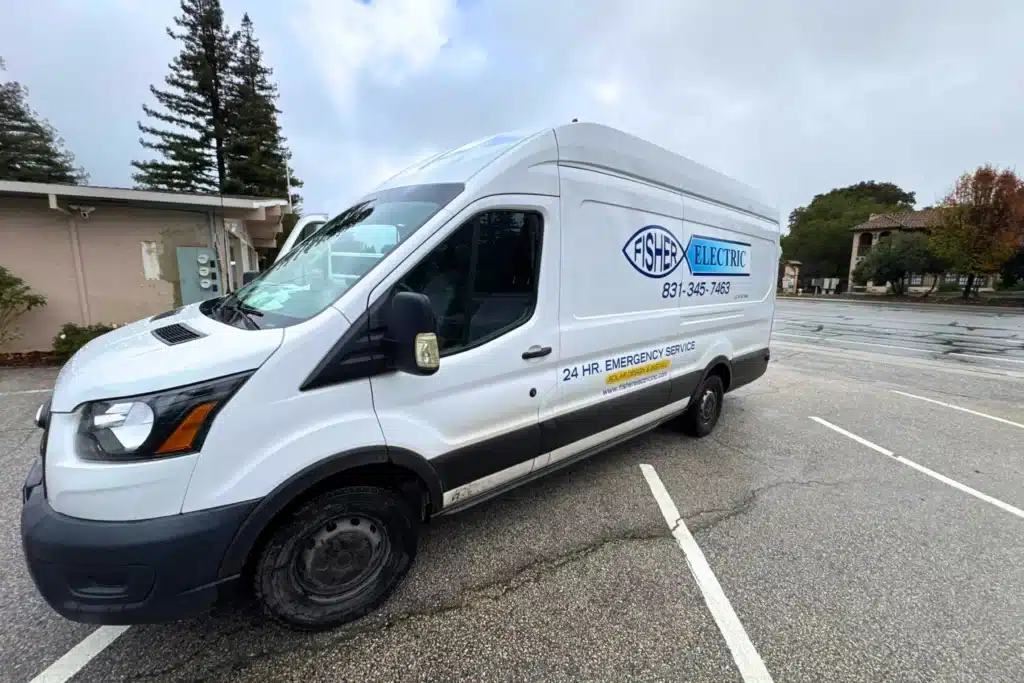
Fisher Electric can look at what you want to keep running, the electrical equipment already in your home, and the backup options that’ll work with it. Contact us today to talk about backup power for your California home before the next outage catches you mid-breakfast.
Sources & References
- Angi – “How Much Does It Cost to Install a Generator in Los Angeles?”
Provides cost estimates for generator installation in the Los Angeles area, including typical project costs and factors that can affect the final price.
https://www.angi.com/articles/how-much-does-it-cost-install-generator/ca/los-angeles - California Public Utilities Commission – “Public Safety Power Shutoffs”
Explains how and why California utilities use Public Safety Power Shutoffs during periods of elevated wildfire risk, including the conditions utilities consider when deciding to de-energize power lines.
https://www.cpuc.ca.gov/psps - EnergySage – “How Much Do Solar Batteries Cost in California?”
Provides current California battery-storage pricing data that can be used to estimate the upfront cost of adding a home battery system.
https://www.energysage.com/local-data/energy-storage-cost/ca - EnergySage – “How Much Do Solar Panels Cost in California?”
Provides current California solar installation costs, including average system pricing and cost-per-watt data.
https://www.energysage.com/local-data/solar-panel-cost/ca - U.S. Department of Energy – “High-Efficiency Refrigerator with Cold Energy Storage Enabling Demand Response”
Provides data on household refrigerator energy consumption, including the estimate used to put home battery capacity and potential backup runtime into perspective.
https://www.energy.gov/cmei/buildings/articles/high-efficiency-refrigerator-cold-energy-storage-enabling-demand-response